Copyright © 2025 Chuangming Coupling (Jiangsu) Co.,Ltd.
How to Select from a Wide Variety of Universal Joints
2026-11-20
SWP Split Bearing Block Cross Shaft Universal Joint
For easier bearing replacement, the bearing housing of the SWP cross shaft universal joint is of split design and fastened by bolts. It is suitable for rolling mill machinery, hoisting and conveying machinery and other heavy-duty machinery, used to connect two transmission shafts with misaligned axes. Rotating diameter: 160~640 mm; Nominal torque: 16~1250 kN·m; Shaft deflection angle: ≤10° for Type A~F; ≤5° for Type G. It functions to couple the two shafts together. The two shafts remain connected during equipment operation and can only be separated after shutdown and disassembly of the joint.
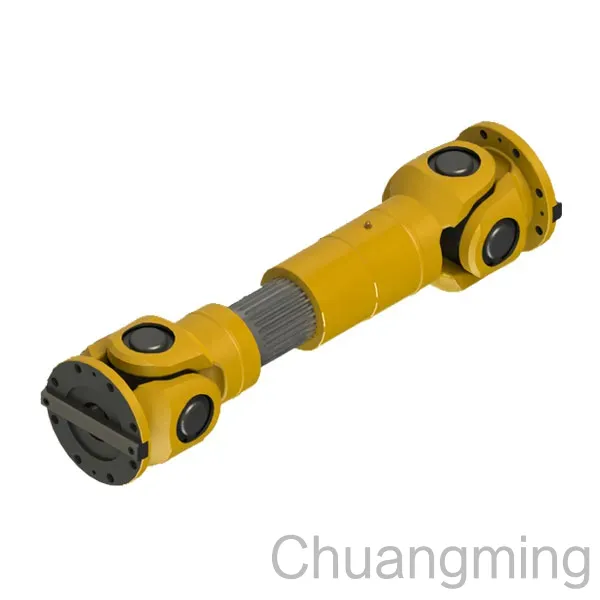
Application
It is a mechanical component that connects two shafts (driving shaft and driven shaft) of different mechanisms for synchronous rotation and torque transmission. In high-speed and heavy-load power transmission, some universal joints can also absorb shock, damp vibration and improve the dynamic performance of the shafting system. A universal joint consists of two halves, which are connected to the driving shaft and driven shaft respectively. Power equipment is generally connected to working machines via universal joints.
National Standard Specifications for Universal Joints
Cross shaft universal joints are the most widely used type of universal joints, and bearings are their vulnerable parts. The main differences among several large-size cross shaft universal joints lie in the design of bearing housings and cross yokes, which form different structural configurations. To guarantee synchronism between the driving and driven shafts, double-joint arrangements are commonly adopted in practical use. The connection methods for double joints are mainly welding or bolted flange connection, and the intermediate length can be customized. Types of cross-head assemblies for cross shaft universal joints are listed below:
· SWC Integral Yoke Cross Shaft Universal Joint (JB/T 5513-2006)
· SWP Split Bearing Block Cross Shaft Universal Joint (JB/T 3241-2005)
· SWZ Integral Bearing Block Cross Shaft Universal Joint (JB/T 3242-1993)
· WS Small-size Double Cross Shaft Universal Joint (JB/T 5901-1991)
· WSD Small-size Single Cross Shaft Universal Joint (JB/T 5901-1991)
· Cross Kits for SWP Cross Shaft Universal Joints (JB/T 7341.1-2005)
· Cross Kits for WGC Cross Shaft Universal Joints (JB/T 7341.2-2006)
The above heavy-duty and small-size cross shaft universal joints are general-purpose types. The automotive industry uses model-specific cross shaft universal joints or other types of universal joints. For example, constant velocity ball joints are used in passenger cars. Besides, mobile machinery such as agricultural machinery and industrial machinery also adopt dedicated universal joints. Cross shaft universal joints are widely used for hoisting applications.
Contact us for high-precision universal joint solutions.Contact way mailbox: wendy@cmcoupling.com, WhatsApp +86 15152901660
During the hot assembly process, the heated component will cool down rapidly, which will affect the assembly quality. Therefore, preparations should be made before the assembly to minimize the assembly time. Before assembling the jaw coupling, the base plate of the reducer should be leveled, and heating and supporting pedestals should be welded on the base plate. The connection between the jaw coupling and the output shaft of the reducer has no tightening device. The torque is transmitted and the weight of the stirring paddle is borne by the assembly's clamping force.
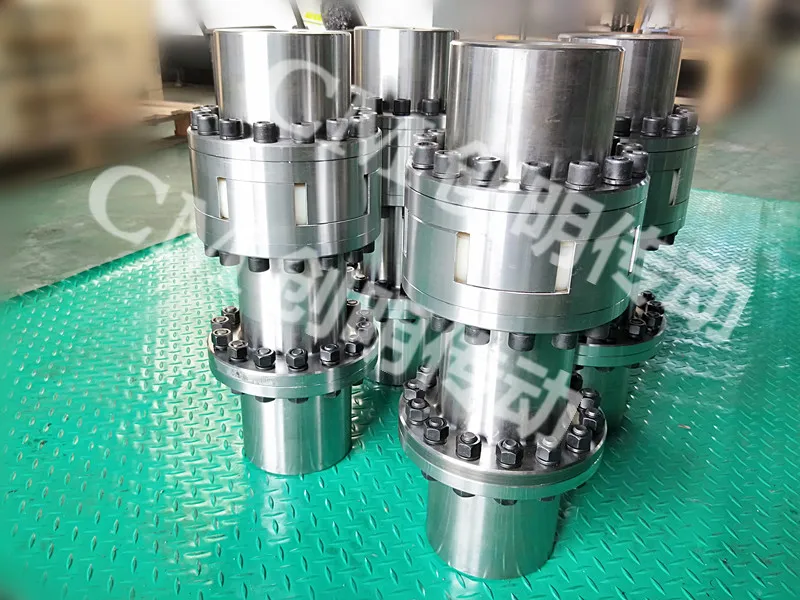
There should be a considerable interference fit between the shaft and the coupling. The assembly should be carried out using the hot mounting method. When assembling parts by hot assembly, the main principle is to utilize the property of objects' thermal expansion and contraction. After heating the accommodating part of the two parts that need to be assembled to a certain degree, they are immediately assembled onto the other component that fits them, reducing the interference fit or even creating a gap for assembly. Through contraction, the predetermined interference fit is achieved.
The hot mounting operation involves placing the component to be heated on a support platform, keeping it as far away from the shaft as possible. Start by using a heating torch to heat it, and continuously move the two heating torches to ensure uniform heating. Observe the the rmocouple instrument or use engine oil to test the temperature to avoid local overheating. Before reaching the heating temperature, continuously measure the hole diameter of the spline coupling with a template. Once the hole diameter template passes through, push the spline coupling to the bottom of the output shaft and align it with the assembly position for installation.
When lifting the jaw coupling, apply force evenly and continuously. If any deviation or jamming is found during the installation process, do not continue the operation. Correct the issue and reassemble. Once the jaw coupling reaches the shaft shoulder position, the assembly is completed. Remove the disassembly tools and slowly cool it down. During winter construction, corresponding protective measures should be taken. The cooling speed should not be too fast to prevent the jaw coupling from deforming or cracking.
Previous: No more data